
BOOKS ABOUT FAITHS (RELIGIOUS LITERACY)
Listed alphabetically by author’s last name. (Click on the blue circle at the right to open and close the book description.)
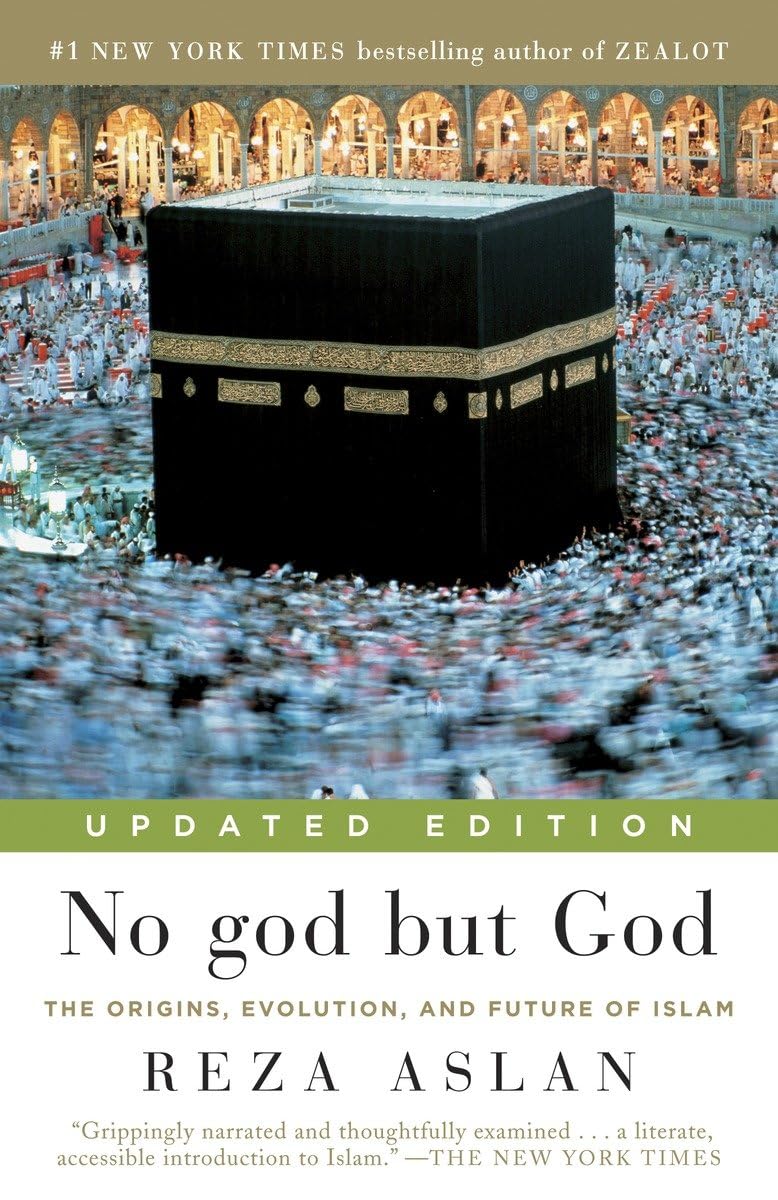
NO GOD BUT GOD: THE ORIGINS, EVOLUTION, AND FUTURE OF ISLAM by Reza Aslan. (2011, Random House)
 Recommended by Ann Carlson
In this book, internationally acclaimed scholar Reza Aslan explains Islam—the origins and evolution of the faith—in all its beauty and complexity. … Aslan explores what the popular demonstrations in the Middle East mean for the future of Islam in the region [and] how the internet and social media have affected Islam’s evolution. … He also provides an update on the contemporary Muslim women’s movement, a discussion of the controvery over veiling in Europe, an in-depth history of Jihadism, and a look at how Muslims living in North America and Europe are changing the face of Islam. (book jacket)
I like that this book is written from a Muslim’s point of view, since much of what is available on US bookshelves about Islam is written by Christian scholars (or Christian apologists). Even though the book is scholarly and heavily footnoted, it is accessible and interesting to the average reader. I especially like that Aslan has the perspective that building relationships across faiths is the only way to truly achieve the kind of interfaith understanding we need to build strong, multi-religious communities.
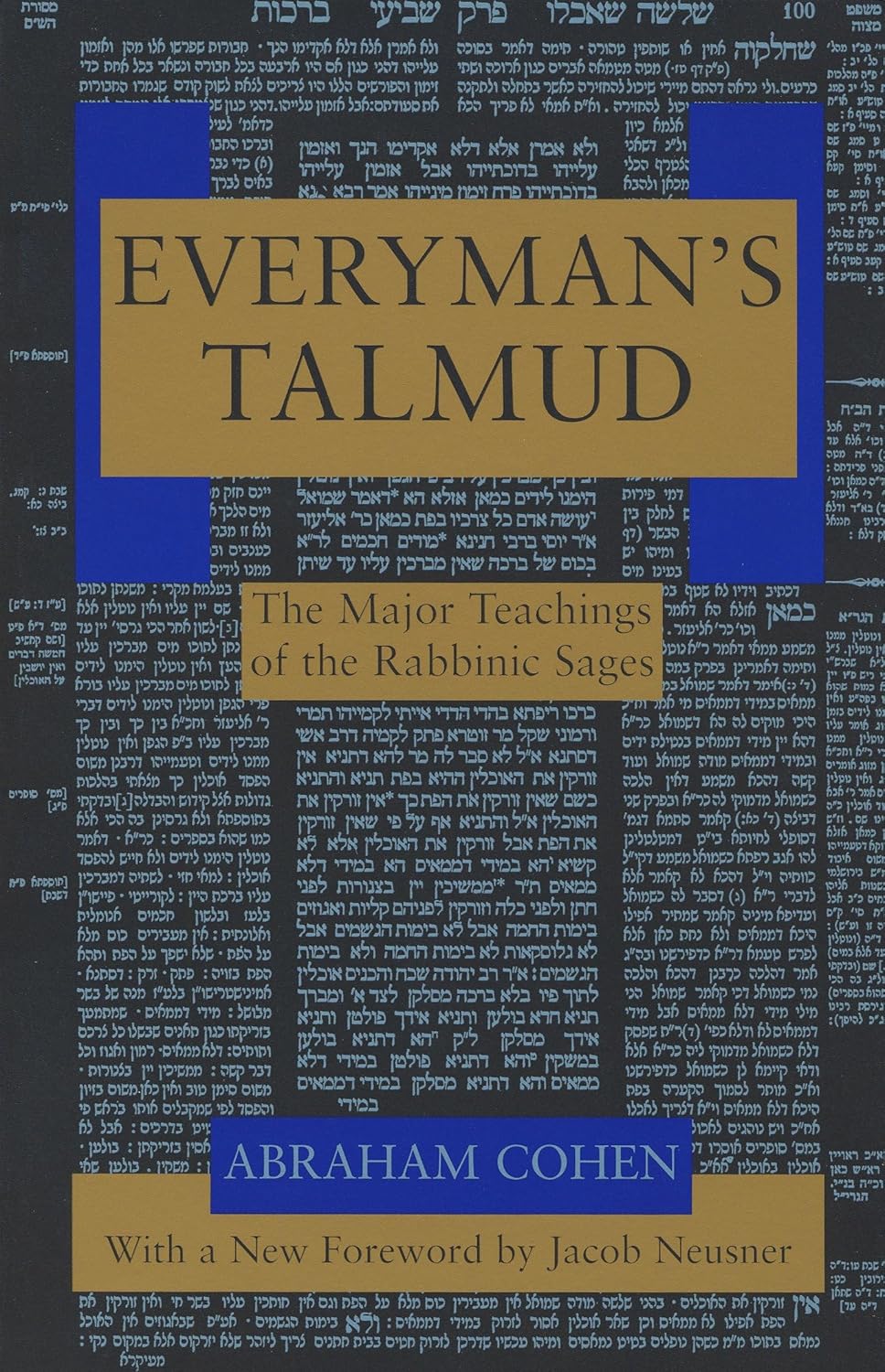
EVERYMAN'S TALMUD by Abraham Cohen, with foreword by Jacob Neusner. (1995, Schocken Books)
 Recommended by Ann Carlson
Originally published in 1945, this book has been long regarded as the classic introduction to the teachings of the Talmud. This comprehensive and masterly distillation summarized the wisdom of the rabbinic sages on the dominant themes of Judaism: the doctrine of God; God and the universe; the soul and its destiny; prophecy and revelation; physical life; moral life and social living; law, ethics, and jurisprudence; legends and fold traditions; the Messiah and the world to come. (book jacket)
As a Christian, knowing our shared Hebrew Bible relatively well, I thought I knew about Judaism. However, after meeting Jewish friends attending services with them, hearing their beliefs, experiencing their customs and rituals–I discovered I knew nothing. This book went a long way in helping me to understand the origin and influence of the theology, stories, and ideas that formed and informed all branches of contemporary Judaism.
WHO SPEAKS FOR ISLAM? by John L. Esposito & Dalia Mogahed. (2007, Gallup Press)
 Recommended by Ann Carlson
What do a billion Muslims really think? Amid the burgeoning anti-Muslim hatred in the West following the 9/11 and other terrorist attacks, Gallop World Poll set about to understand just that. People were constantly asking: Why don’t Muslims speak up? Why is there so much anti-Americanism in the Muslim world? Why do Muslim women put up with how they are treated?
Were American’s largely-negative views of Muslims deserved? What would the world’s Muslims have to say for themselves? Gallop decided to discover just that. This book is the result of an around-the-world poll. It brings data-driven evidence of the complex and multi-faceted thinking of the world’s Muslims on these and other questions.
This book is very useful for gaining a better insight into Islam as it is experiences by vastly different cultural and national groups. It provides often surprising insights that are also a good check, in general, on one’s tendency to stereotype and assume.
LIVING RELIGIONS by Mary Pat Fisher. (2016, Pearson)
 Recommended by Ann Carlson
Currently the “go to” text for college classes on world religions, this is a comprehensive survey of the world’s religions. It explores historical developments and teachings of traditional faiths, indigenous religions, new religious movements, and the evolutions of religions over time toward contemporary practices and beliefs. The book draws on a wealth of academic research and, importantly, on firsthand source material and the diverse voices of adherents of the various faiths.
While a pricey prospect if you want to purchase one of the more recent editions, it is an advantage that this book has gone through 10 complete editions, with multiple printings and formats for each one. On the used book market, you can purchase this very useful reference resource for your library relatively cheaply. Alternatively, take advantage of your local library to view a recent edition and discover how the world of religions is changing.
THE PATH OF EMANCIPATION by Thich Nhat Hanh. (200, Parallax Press)
 Recommended by Ann Carlson
This book comprises and in-depth instruction in the “Sixteen Ways of Breathing” (as presented in the Pali Canon of the Buddha’s instruction on using awareness of breath). It is based on a transcription of talks from a 21-day mindfulness retreat.
Thich Nhat Hanh shows how it is possible to slow down and get in touch with our breathing. He teaches the practice of mindful breathing, walking, and sitting, and how the practice of mindfulness releases suffering and leads to a wholesome and happy life. (book jacket)
Nhat Hanh is probably the most well-known and accessible teacher to introduce the essentials of Vietnamese Buddhism and mindfulness practice to Western audiences. I have, and love, many of his books. There is always so much to take away, think about, and practice — either from in-depth study or just dipping into them from time to time.
THE WORLD'S RELIGIONS by Huston Smith. (2009, HarperOne)
Recommended by Ann Carlson
Originally published in 1958, this textbook was long the standard college textbook on world religions. Smith’s book has gone out of fashion in the 21st Century because, while it covers the world’s largest and most predominant religions, it does not cover the multiplicity of religious traditions considered representative in today’s more diverse and global society. Yet whatever the book lacks as a modern textbook, it more than makes up for as a timeless approach to thinking about religion. The sections on religions are primarily written from Smith’s own, varied experiences.
I particularly liked this book because Smith’s delightful perspective is not that of the standard scholar of religion, nor of a typical believer or adherent trying to explain their belief. In each case, his is the attitude and enthusiasm of someone who has fallen deeply in love with that tradition and is enraptured by it. Not naïve about the pitfalls of religion, nor of the devastation of religious strife, Smith nevertheless recalls to us the profound wonder, wisdom, and power of faiths that have guided and sustained communities for millennia. What might happen if we could each learn to see our own and each other’s religions through the eyes of new love?
THE SOUL OF CHRISTIANITY by Huston Smith. (2005, HarperOne)
 Recommended by Ann Carlson
Huston Smith writes that “simply to be human is to long for release from mundane existence with its confining walls of finitude and mortality. The Good News of authentic religion—in this book, Christianity—is that that longing can be fulfilled.”
From the book jacket: Bestselling author Huston Smith stakes out a path between culturally rigid, intolerant evangelical and fundamentalist Christianity and nontranscendent, liberal Christianity. He presents a convincing argument for a vital alternative that is a deeper, more authentic faith, a faith that guided the Church for its first thousand years.
What I particularly like about Smith’s writing is that he can be a passionate advocate for the truth and beauty of Christianity without ever losing sight of the knowledge that it is but one authentic religion and one authentic way to understand God.
BAHA'I BASICS: A GUIDE TO THE BELIEFS, PRACTICES, AND HISTORY OF THE BAHA'I FAITH by Frances Worthington. (2012, Baha'i Publishing)
 Recommended by Tom Julius
What is the Bahá’í Faith? What are its basic principles and teachings? When and where did it begin? What does it have in common with the other major religions of the world? How is it different? Who was its Founder? What does the Bahá’í global community look like today?
In Bahá’í Basics, Frances Worthington uses a simple and accessible format that highlights the clarity with which topics associated with the Bahá’í Faith are discussed. The result is an easy-to-use, informational introduction to what is one of the fastest growing religions in the world. (book jacket)
This book provides clear, engaging, and straightforward answers to the basic questions that arise when investigating a new religion.
“When Baha’u’llah proclaimed His Message to the world in the nineteenth century He made it abundantly clear that the first step essential for the peace and progress of mankind was it’s unification.”
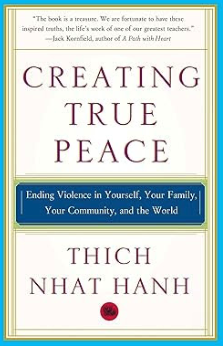 “Creating True Peace is both a profound work of spiritual guidance and a practical blueprint for inner and global change …Thich Nhat Hanh uses a beautiful blend of visionary insight, inspring stories of peacemaking, and a combination of meditation practices and instruction to show us how to take Right Action.” — book jacket